

Media contacts
Green Target
Five takeaways from Shaping FX / Leaders in FX – New York

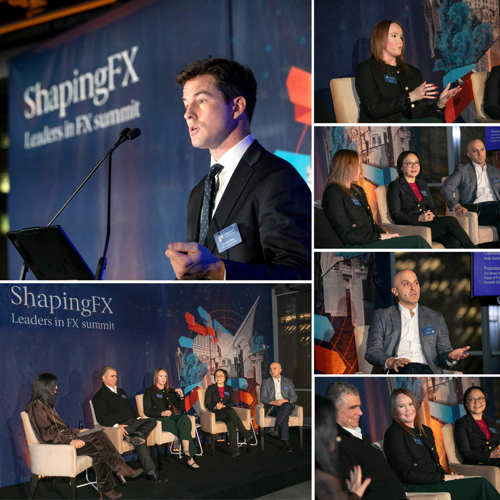
Our second annual ShapingFX / Leaders in FX summit took place in New York City. The event brought together participants from across the public and private spheres to network and share collective insights on the current state of the financial market and the future of FX.
“The global financial system is one of the most interconnected ecosystems on Earth” remarked Matthew Blake, Head of the Centre for Financial and Monetary Systems at the World Economic Forum. His keynote address reflected on the themes that have defined the year so far, including the rise in fragmentation across the financial system, its impact on FX markets and liquidity, and the growing momentum around stablecoins. The subsequent panel discussions explored these topics further.
How does geopolitical uncertainty affect the FX market?
Geopolitics and finance are inextricably linked. What can seem like small moves in one area can result in huge shifts in another. 2025 has been no exception: a volatile year driven by geopolitical headwinds around the globe.
Elevated geopolitical tensions have translated into increased volatility across FX markets. As she introduced the first panel, Lisa Danino-Lewis noted that average daily traded volumes at CLS have risen steadily throughout the year. Ongoing tariff disputes have remained in the spotlight, with spot FX traded volumes
surging around major events like the “Liberation Day” announcement of US tariffs.
On that day spot volumes submitted to CLS reached the second-highest level on record and remained high throughout the month.
Other notable developments included the continued pressure on the USD/HKD peg in May and June,
escalating tensions in the Middle East in early June, and political shifts in both France and Japan.
2025: a year marked by significant volatility
Panelists remarked that in some ways, 2025 has been a positive year for FX markets. Volatility has driven higher activity. What makes 2025 unique is the scale of regulatory fragmentation, as competing regimes
increasingly diverge.
On the sell side, banks now face the challenge of operating across multiple regulatory frameworks while managing different client expectations across regions.
“Fragmentation has increased the overall FX industry revenues, but the risks are also bigger. We all have to engage and work very closely with the regulators and policymakers around the world to be able to sustain our ability to be a global player and service our clients effectively” observed Francisco Oliveira of Société Générale.
One other factor that has set 2025 apart is the performance of the dollar. During the first six months of the year, the dollar experienced rapid depreciation, one of the weakest performances in the past 50 years.
On the buy side, this has focused client conversations on hedging decisions and dollar valuation versus
dollar dominance.
“They are two different concepts. Dollar dominance is structural, but dollar valuation, just like for any asset class, can go up or down. They are different,” noted Yan Pu of Vanguard.
Business operations have had to evolve to adapt to the market developments of this year. The world has become more complex while evolutions in technology enable more and more access to information. Businesses are working to not only leverage this data, but also to structure it properly to enable greater efficiency and ultimately drive better investment decisions. Risk management has also become even more of a focus.
“We’ve stepped up our risk management approach to what we’re doing in the firm. That comes in the form of stress testing – asking questions like ‘for portfolio X, if treasuries move this way how would it hold up?’” shared Cat Lawlor from Baillie Gifford.
2026 will feature more of the same with both risks and opportunities
The only certainty we have is that uncertainty is likely to persist in 2026. The industry is moving at an elevated pace with no signs of slowing down. Central bank divergence remains a theme as monetary policy tightens in certain regions and loosens in others. Geopolitical tensions endure, including in the Asia Pacific region, and uncertainty around dollar valuation continues – both triggers for further market volatility in 2026.
For emerging markets investors, FX volatility has become a more prominent driver of portfolio outcomes
given the pronounced moves in 2025, and it is now becoming a part of overall portfolio risk. As a result, reliance on specialist FX expertise to manage the risk is increasing.
With the rapid development in technology, innovation is set to play an increasingly important role in financial markets in 2026 and beyond. It remains to be seen how the transition from traditional uses of money to digital assets – such as stablecoins – will look. It will come down to holding assets in central bank reserves, money market funds and traditional cash and deposits.
The move to faster settlement continues to pick up pace in the securities market, with T+1 adoption expanding and T+0 gaining traction. The supporting infrastructure around settlement and payments in the retail market is also advancing rapidly. However, the FX market, which sits in the middle, hasn’t changed much in the last 25 years.
“One of the main drivers is, how do we all do this together? There’s a role for CLS to play if the FX market is going to transform and be ready, to prepare market participants for everything that is to come,” offered Jason Vitale, of BNY.
Can stablecoins play a role in the FX world?
“The world is changing rapidly, and we are all running to catch up,” this quote from the first Jurassic Park movie remains as true today as it was 30 years ago. The question is whether digital assets will eventually change the finance sector the way CGI technology in Jurassic Park altered movie-making forever. Stablecoins, the focus of the second panel hosted by Dirk Bullmann, are currently experiencing a renaissance, after first appearing over ten years ago.
Stablecoin use cases are expanding beyond the crypto environment
While the instruments are relatively new, many of the underlying concepts are not.
“There are similarities between how stablecoins may be leveraged and the way traditional finance operates today. A blockchain wallet functions as a means to hold and transfer value, similar to an account in traditional finance. A token represents a unit of value, which can correspond to various asset types. In the case of stablecoins, it is an asset operating on blockchain rails,” shared Dan Doney from DTCC.
What differentiates this new technology from traditional mechanisms is decentralization. Blockchain
provides a single set of rails for multiple asset types rather than using different systems for securities, cash
and private or public assets. This introduces programmability that, allows compliance and market rules to be embedded directly into assets, creating more possibilities.
Stablecoin growth accelerated in 2025, creating a lot of hype across the industry. While the passage of the
GENIUS Act in the US has piqued interest for many institutions, the growth of stablecoins remains modest relative to the overall market. This is because many current stablecoin use cases are still native to the crypto markets, though use cases within the payments world are increasing.
“Post GENIUS Act, we’ve seen a huge amount of interest from everywhere from our credit union clients all the way through G-SIBs that are actively building and looking to activate use cases in this space because of the regulatory clarity that’s emerging” said Rebecca Carvatt from EY.

Interest also appears to be growing beyond the US. While full regulatory convergence remains elusive, conversations around the use of stablecoins and the mainstream use of other digital assets are peaking.
Infrastructure is needed for stablecoins (and other digital assets)
The increase in use cases for digital assets in traditional finance raises the question of whether the existing system needs to expand and evolve to accommodate them.
“This isn’t about replacing existing infrastructure. The current system works and underpins global finance. What we’re doing is extending it, using new technology where it adds value, so tokenized assets can benefit from the same trust, standards, and interoperability that banks rely on today” shared Jonathan Ehrenfeld from Swift.
Swift is working with its community to design a distributed ledger. The first iteration is unlikely to support stablecoins, instead focusing on tokenized deposits to show it can achieve the same benefits as keeping money in the banking system. Subsequent iterations are expected to accommodate more asset types.
Alongside this, Circle, which launched its flagship USDC stablecoin in 2018, began developing Arc in response to conversations with customers and other stakeholders around the shortcomings of
existing systems. Arc is a blockchain infrastructure that supports stablecoin payments, FX and capital markets applications.
The FX use case for stablecoins is unclear but developing
Though the stablecoin market is still relatively small, mainstream use cases are expanding as part of the global payments’ infrastructure. But whether there is a concrete use case within the wholesale FX sphere is less clear.
One of the barriers is the availability of mainstream custodians for digital assets. “Several large traditional institutions are now offering custody for digital assets, as well as digital natives that are backing those offerings. That’s needed to enable some of those FX use cases,” remarked Rebecca Carvatt from EY.
Swift recently went some way to progressing exploration in this area. Its trial with Citi demonstrated that it is possible to settle fiat-to-digital transactions using PvP. Though it is not ‘perfect PvP’, it does open the door for functional interoperability between traditional financial systems and distributed ledger technology.
“I think the current FX use case is not fully there yet because the majority of stablecoins are dollar stablecoins. Part of that is because the assets are not on chain yet. Once you have a large amount of local currency fixed income assets being brought on chain through organizational efforts, it naturally establishes more of an FX market” said Gordon Liao of Circle .
The biggest difference with stablecoin-based FX is the convergence of settlement and price. Liquidity optimization is a key consideration in FX, and any solution would need to take this into account, as well as the mitigation of settlement risk.
While the FX use case continues to develop, clearer regulatory frameworks, ongoing research and development and increasing collaboration across the ecosystem are driving progress. However, when we will see full integration between traditional financial infrastructure and DLT, and which digital assets will prove most effective for widespread adoption, remains uncertain.
Panel 1
-
Cat Lawlor - Multi Asset Trader - Baillie Gifford
-
Francisco Oliveira - Co-Head of Global Markets & Global Head of Fixed Income & Currencies - Société Générale
-
Yan Pu, Head of Global FX – Vanguard
-
Jason Vitale, Global Head of Foreign Exchange, Fixed Income, Equities and Capital Markets - BNY
Panel 2
-
Rebecca Carvatt, Partner, Banking and Capital Markets, EY
-
Dan Doney, Chief Technology Officer, DTCC Digital Assets
-
Jonathan Ehrenfeld, Head of Strategy, Swift
-
Gordon Liao, Chief Economist and Head of Research, Circle


